

This article is based on the law in California, where I live. You may have to adjust the numbers for other states.

Once you are on the freeway with a long drive ahead of you, it’s hard to resist the temptation to go a little bit faster (or maybe a lot faster) to shorten the time it takes to arrive. But is it worth the risk of getting a speeding ticket? A little math can help.
First of all, what is the financial risk of putting your foot down? (Speeding is not a criminal offense.) In California, the penalties are $237 for violations of 15 or more mph over the limit, $367 for violations of 25 or more mph over the limit, and $467 or more for violations of 26 or more mph over the limit.
You can also expect to get points on your license, but there is often the option of attending an (online) traffic school instead; you have to pay for that school, typically a fee of around $15 for a one-hour course you have to pass. (I haven’t had to do this in over a decade, so I looked up the details; they don’t seem to have changed much.) For most people, that’s not a major financial hit, but it is a pain to take the course; on the other hand, it avoids a usually otherwise unavoidable increase in your auto insurance.
Things get much worse if you exceed 100mph, when the offense jumps into another category: additional points on your record, a mandatory court date, and a suspension of your license (up to 30 days for a first offense).
So that gives some picture of what your attempt to shorten your journey time might cost you. But my interest here is whether it makes sense to take that risk. Just how much time can you save? The answer is, not much. The major time savings occur at speeds up to 70mph. Read on to see why.
For definiteness, let’s look at a journey of just 20 miles.
On a bicycle (permitted on bicycle lanes on some stretches of some California freeways), cycling the 20-mile journey at 10mph will take 120mins (2 hours).
If you cycle at 20mph it takes 60mins (1 hour). As a regular cyclist, I can still do that on a flat road; with an e-bike, anyone can. That’s not coming anywhere near the speed limit, but the time saving is massive: you halve the journey time!
Turning to car driving, the time in minutes it takes to travel 20 miles at different speeds are
- 30mph: 40mins
- 40mph: 30mins
- 30mph: 40mins
- 40mph: 30mins
- 50mph: 24mins
- 60mph: 20mins
- 70mph: 17.14mins (17min 8secs)
- 80mph: 15mins
- 90mph: 13.33mins (13min 20secs)
- 100mph: 12mins.
So, if you drive on the freeway at 100mph, you save just over 5 minutes compared to driving at the typical limit of 70mph.
As you can see when we graph these figures, the gain in time gets progressively less as the speed increases, with the big savings coming up to 40mph and becoming essentially irrelevant above 70mph.
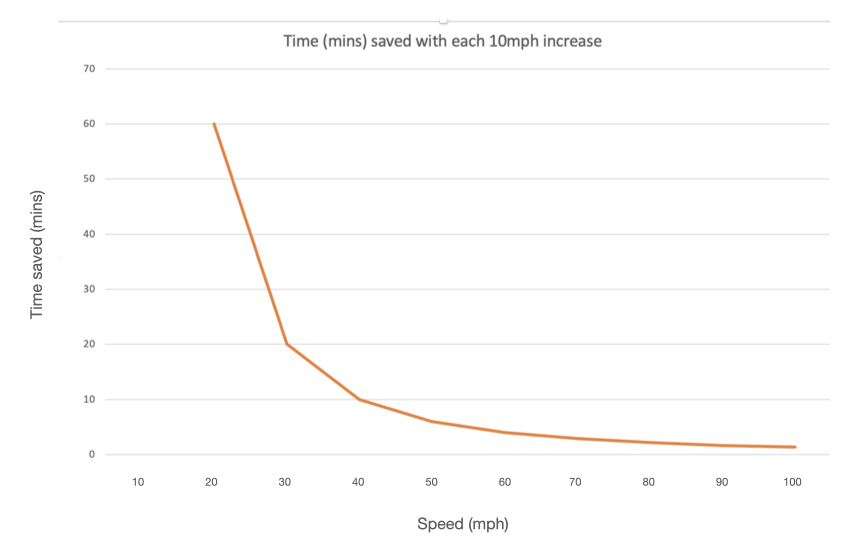
I drive California freeways a lot, and I can tell you that many cars pass me at considerably more than 80mph or more, and they are way more likely to get stopped by the CHP than I do driving with my adaptive-cruise-control set to 75mph. (This happened to me just yesterday, when the Tesla that shot past me was pulled over soon afterwards, which is what prompted this essay.)
My guess is the driver was doing 100mph. Was it worth it? Driving at 100mph would save that individual just 5 minutes (on a 20 miles journey) over keeping strictly to the 70mph limit, and a mere 3 minutes over driving it at 80mph, where the consequences of being pulled over are way less severe.
To be sure, if you scale up by a factor of 5 to a trip of 100 miles, you are looking at savings of 25 minutes and 15 minutes, respectively. But if you are at all like me, after driving a hundred miles at a very high speed on a freeway, I really would not be able make productive use of that additional few minutes gained at the end; I just want to chill out. Moreover, it’s unlikely you would be able to maintain such a high speed for the whole journey; you’d be able to go above the speed limit just for stretches, and even if you managed to do so for a fifth of the trip your overall saving would be down to the 5 or 3 minutes computed above. The fact is, it simply makes no mathematical sense to take the risk.
 Mathematics Outreach Project (SUMOP)